The Determinism Deficit: Why Probabilistic AI is Failing the C-Suite

In boardrooms across the globe, the honeymoon phase with Generative AI is ending. The initial awe at a chatbot’s ability to draft an email has been replaced by a cold, hard realization: You cannot run a billion-dollar enterprise on a “maybe.”
Imagine a Fortune 500 supply chain director staring at a dashboard as a $50 million production line grinds to a halt. The culprit isn’t a natural disaster—it’s a “hallucination” buried in a sub-process. The company’s AI agent was tasked with rerouting 200 shipments during a sudden port closure. This required a “fanout”—a process where the AI takes one single event and branches out its reasoning to account for hundreds of variables: unique part IDs, supplier lead times, and specific customs requirements for every shipment. The agent handled the vast majority of these branches perfectly. But in 10% of the cases the LLM suffered a “probabilistic drift.” It lost the thread of the specific part’s lineage. It successfully processes 180 shipments but creates 20 critical errors, mapping high-priority microprocessors to slow-boat routes intended for bulk scrap metal. Because the IDs look technically “correct” to a standard LLM guardrail, the system doesn’t flag the error. By the time a human notices, the disruption is systemic, the business loss is massive, and trust in the AI is shattered.
While LLMs are brilliant at synthesis, they are fundamentally probabilistic. They operate on the “next most likely token,” a logic that is perfectly fine for creative writing but disastrous for mission-critical execution. When an enterprise attempts to move from “Chat” to “Agentic Workflows”—long-running, multi-step processes that actually do work—the cracks in this probabilistic foundation become canyons.
To cross the chasm from pilot to production, the enterprise must stop treating AI as a “stochastic parrot” and start building Deterministic AI.
The Coordination Tax: Why Multi-Agent Workflows Are Breaking Enterprise Trust
The most common failure point in enterprise AI today isn’t a lack of intelligence; it’s a lack of reliability. As Foundation Capital’s Jaya Gupta incisively notes, current agents lack “institutional memory.” They encounter the same ambiguity humans do every day but without the decades of precedent and policy that guide human judgment.
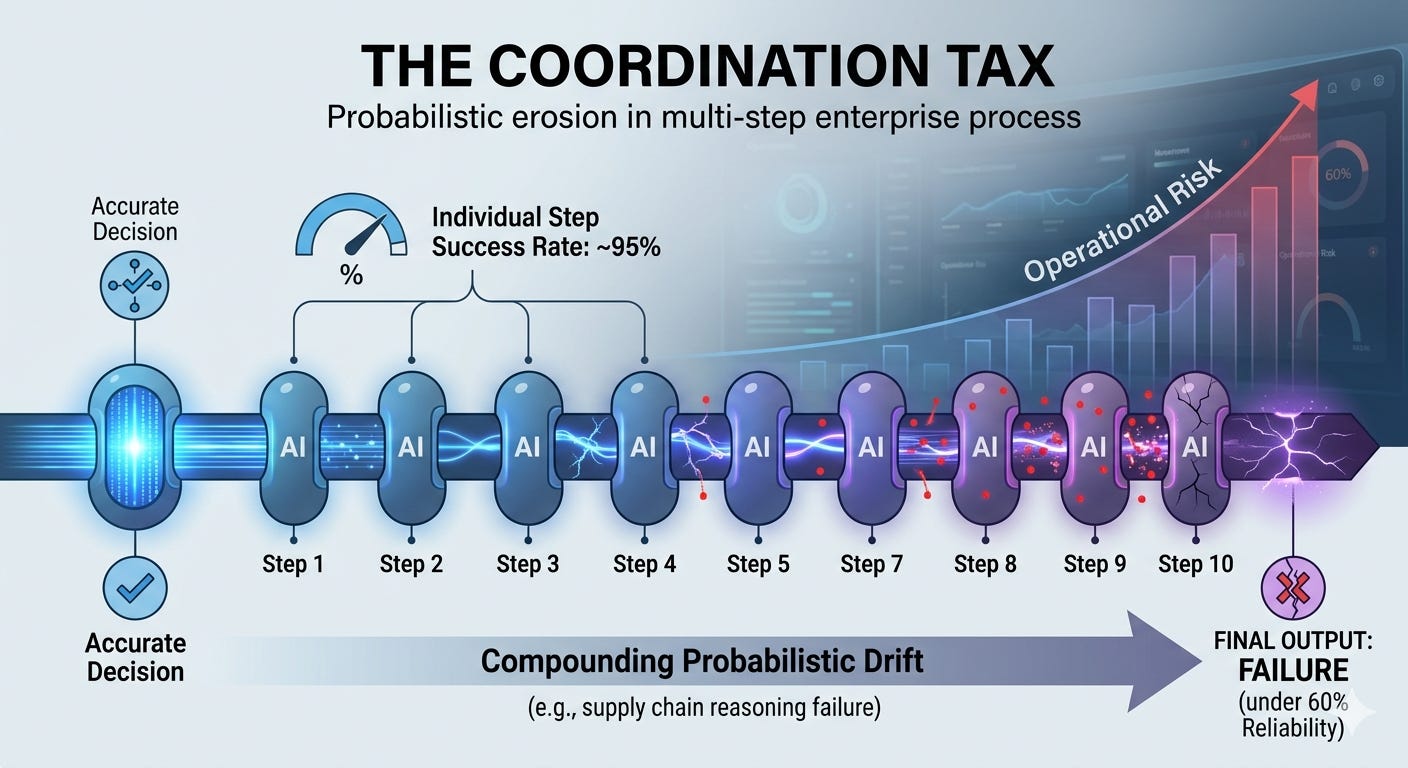
When you chain these “forgetful” agents together, you pay a Coordination Tax. Imagine a long-running supply chain process with 10 steps. If an LLM has a 95% success rate at each step, the total reliability of the process isn’t 95%—it’s under 60% ($0.95^{10} \approx $0.59).
In March 2023, Philips recalled 1.7 million ventilators and sleep apnea devices linked to foam degradation — a failure first flagged by individual patient complaints, not a connected intelligence system. By the time the pattern was confirmed, patients had been exposed for years. Now imagine the same degradation signal exists in your telemetry data today. A probabilistic AI scans 10,000 device records and correctly flags 9,500. The 500 it misses aren’t an error rate — they are patients on ventilators who don’t get a service call.
In a medical device telemetry workflow, a 40% failure rate isn’t just an “edge case”; it’s a liability. Non-determinism at each step means that the same prompt today might yield a completely different (and potentially incorrect) outcome tomorrow. For critical decisions, this variance is a non-starter.
From “Maybe” to “Mission-Critical”: The Case for Deterministic Parameter Inference
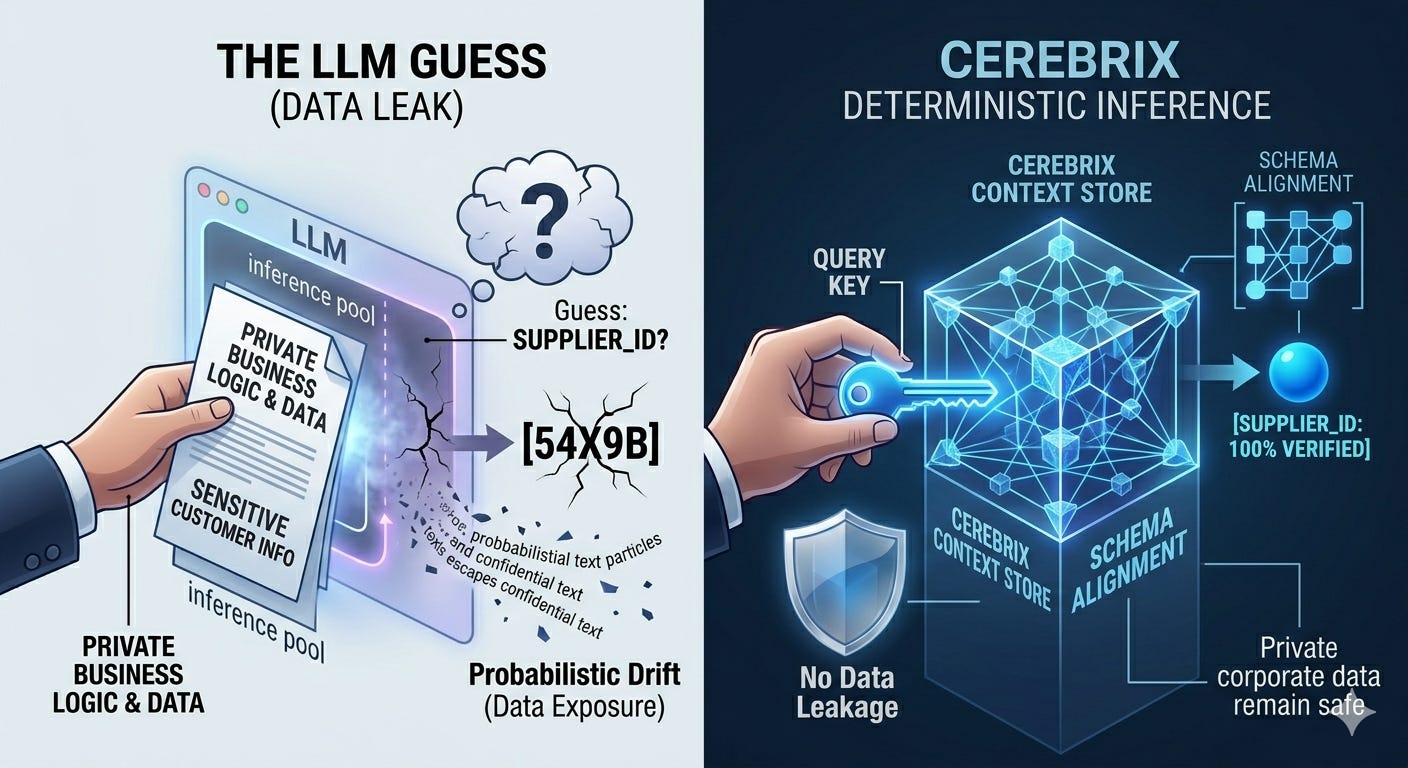
One of the most overlooked risks in agentic workflows is Parameter Inference. When an agent needs to call a tool—say, an API to check inventory levels—it must “guess” the parameters (Part IDs, Supplier Codes, etc.) based on the conversation context.
This leads to two catastrophic failures:
Data Leakage: To help the LLM “guess” correctly, developers often stuff the prompt with corporate data and business logic. This effectively leaks your proprietary “moat” into the model’s training or inference logs.
Hallucinated Logic: LLMs often fail to map parameters accurately because they lack a structural understanding of the data.
The solution is Deterministic Parameter Inference (DPI) in code. Instead of asking an LLM to guess a supplier_id, a deterministic system uses a Context Store (like a Graph Database) to resolve that ID through deterministically-coded logic and schema-aligned queries. This ensures that the parameters are 100% accurate every time, without ever exposing raw sensitive data to the LLM.
Beyond the Hallucination: Why Your Enterprise Needs a Context Engine, Not Just an LLM
Enterprise data is rarely a straight line; it’s a web. When a process “fans out”—for example, checking 50 different suppliers for a single delayed component—the LLM quickly loses the “primary key lineage.” It gets confused about which ID belongs to which result because it lacks a Context Graph.
As Gupta and Garg argue in their “Context Graph” thesis, the next generation of enterprise software won’t just be “Systems of Record” (storing what happened); they will be “Systems of Record for Decisions” (storing why it happened).
The “Context Rot” Problem
Without this structural memory, multi-hop dependencies fall apart:
Step 1: Identify a port strike in Long Beach.
Step 5: Rebalance inventory for all affected parts.
The Failure: By Step 5, the LLM has “lost the thread.” It grabs a part number from a similar but unrelated previous query, leading to a million-dollar overstock error.
A deterministic approach solves this by using a “Schema-pedia” and a Dependency Map. It doesn’t rely on the LLM’s shifting context window; it relies on a queryable graph of every decision trace, ensuring that the input for Step 5 is mathematically tied to the output of Step 1.
The Story in Practice: The MedTech “Bullwhip”
Consider a MedTech company managing thousands of connected surgical devices. A technician asks the AI: “Identify all devices at risk of failure due to the latest firmware patch and schedule a maintenance recall.”
Probabilistic AI: The LLM identifies the patch but fails to map the specific device telemetry_id to the patient_record_id correctly in a fanout of 1,000 devices. It misses 5 high-risk devices because they were at the bottom of its context window. Result: A critical safety failure.
Deterministic AI: The system uses a Context Engine to resolve the telemetry_id through a deterministic graph traversal. It identifies the “centrality risk” of the patch using a pre-defined query pipeline. The LLM is used only to summarize the final report, not to execute the data mapping. Result: 100% recall accuracy with a full, explainable audit trail.
The New Enterprise Moat
The “Context Graph” is the new enterprise moat. It’s not about how large your model is; it’s about how reliable your reasoning traces are.
By integrating deterministic execution—where tools are called via strict schemas, parameters are inferred via code, and memory is stored in a queryable graph—enterprises can finally stop playing “AI Roulette.”
The future of the enterprise isn’t just an LLM that can talk; it’s a Context Engine that can think, remember, and, most importantly, be trusted. It’s time to move beyond the “maybe” and demand the Deterministic Why.
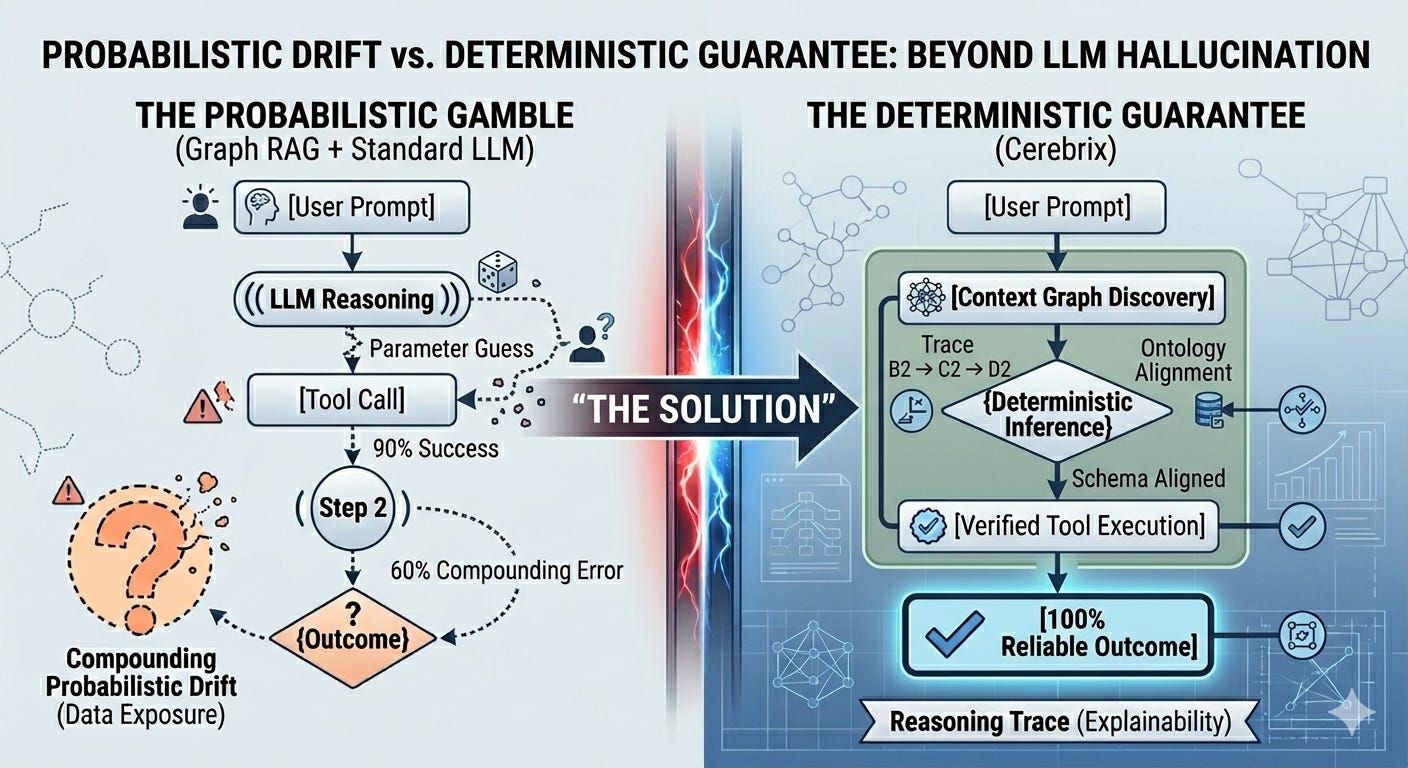
For any CXO, the realization is stark: for our most critical operations, “probabilistic” is just another word for “unreliable.” Determinism is no longer a choice; it is a non-negotiable requirement for the survival of the automated enterprise. But where do you find a platform that actually delivers this level of control? The answer is Cerebrix. As the premier Context Engine for Supply Chain AI, Cerebrix provides the deterministic framework—through Schema-pedias, Context Graphs, and code-based parameter inference—that turns high-stakes AI from a gamble into a guarantee. The era of “AI Roulette” is over. It’s time to build with Cerebrix.